
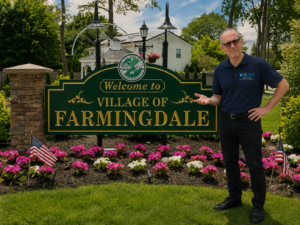
If you live in Farmingdale or South Farmingdale, chances are you’ve thought about your drinking water at some point. Maybe you’ve noticed a strange taste. Maybe you’ve read news stories about contaminants on Long Island. Or maybe you’ve simply wondered what exactly is coming out of your tap.
The good news is that local water suppliers test their water regularly and work hard to meet state and federal drinking water standards. But that doesn’t mean there aren’t challenges. In fact, Long Island’s sole-source aquifer faces some of the most complex water-quality issues in the country.
PFAS: The “Forever Chemicals”
One of the biggest concerns in Farmingdale and South Farmingdale tap water is a group of chemicals known as PFAS, often called “forever chemicals.” These man-made compounds were used for decades in products ranging from non-stick cookware to firefighting foam. Because they break down very slowly, they can remain in groundwater for many years.
While local water providers have invested heavily in treatment technology to remove PFAS, many homeowners still want to know whether these compounds have affected their water and what additional protection may be available at the point of use.
The Challenge of 1,4-Dioxane
Another contaminant found in Farmingdale and South Farmingdale tap water that has received significant attention is 1,4-dioxane. This industrial chemical has been found in groundwater throughout Nassau and Suffolk Counties.
Unlike many contaminants, 1,4-dioxane is difficult to remove and requires specialized treatment systems. New York State has adopted some of the strictest standards in the nation for this contaminant, leading many water suppliers to make substantial investments in treatment infrastructure.
Industrial Chemicals Beneath Long Island
Farmingdale and South Farmingdale residents are also concerned about volatile organic compounds, or VOCs. These chemicals can come from industrial activities, dry cleaners, manufacturing operations, and historical groundwater contamination.
Long Island has a long industrial history, and some of those legacy contaminants continue to require monitoring and treatment today. Water providers continuously test for these substances and operate treatment systems where necessary.
Nitrates and Groundwater Quality
Nitrates are another issue. Fertilizers, lawn chemicals, and septic systems can all contribute to elevated nitrate levels in groundwater that eventually makes its way into the taps of Farmingdale and South Farmingdale residents.
Because Long Island relies entirely on groundwater for its drinking water supply, protecting the aquifer from nitrate contamination remains an ongoing challenge. Municipal water systems carefully monitor nitrate concentrations, but many homeowners still choose to learn more about the quality of the water entering their homes.
Don’t Forget About Lead
Lead is usually not found in the water source itself. Instead, it can enter drinking water through older plumbing, fixtures, and solder inside Farmingdale and South Farmingdale homes.
That’s one reason many homeowners choose to have their water tested, especially if they live in an older house. Even when water leaving the treatment plant meets all standards, conditions inside a home’s plumbing system can affect water quality at the tap.
Why More Homeowners in Farmingdale and South Farmingdale Are Testing Their Water
According to Mark Shmidt, founder and president of Long Island Clean Water Service, “Many homeowners are surprised to learn how much effort goes into protecting Long Island’s drinking water. The water delivered to their home may meet all standards, but that doesn’t mean they shouldn’t understand what’s in it. Testing is the first step toward peace of mind.”
The reality is that every home is different. Water quality can vary depending on the age of the home, the plumbing materials, and even which neighborhood you’re in.
Schedule a Free Water Test and Get Answers for Your Family
That’s why Long Island Clean Water Service offers complimentary in-home water testing for homeowners throughout Farmingdale and South Farmingdale. A professional water analysis can help identify potential concerns and determine whether additional testing or treatment might be appropriate.
After all, when it comes to the water your family drinks every day, knowing what’s in it is always better than guessing.